Downsizing, decluttering, or staying put? Housing choices later in life - part 3
Categories: retirement
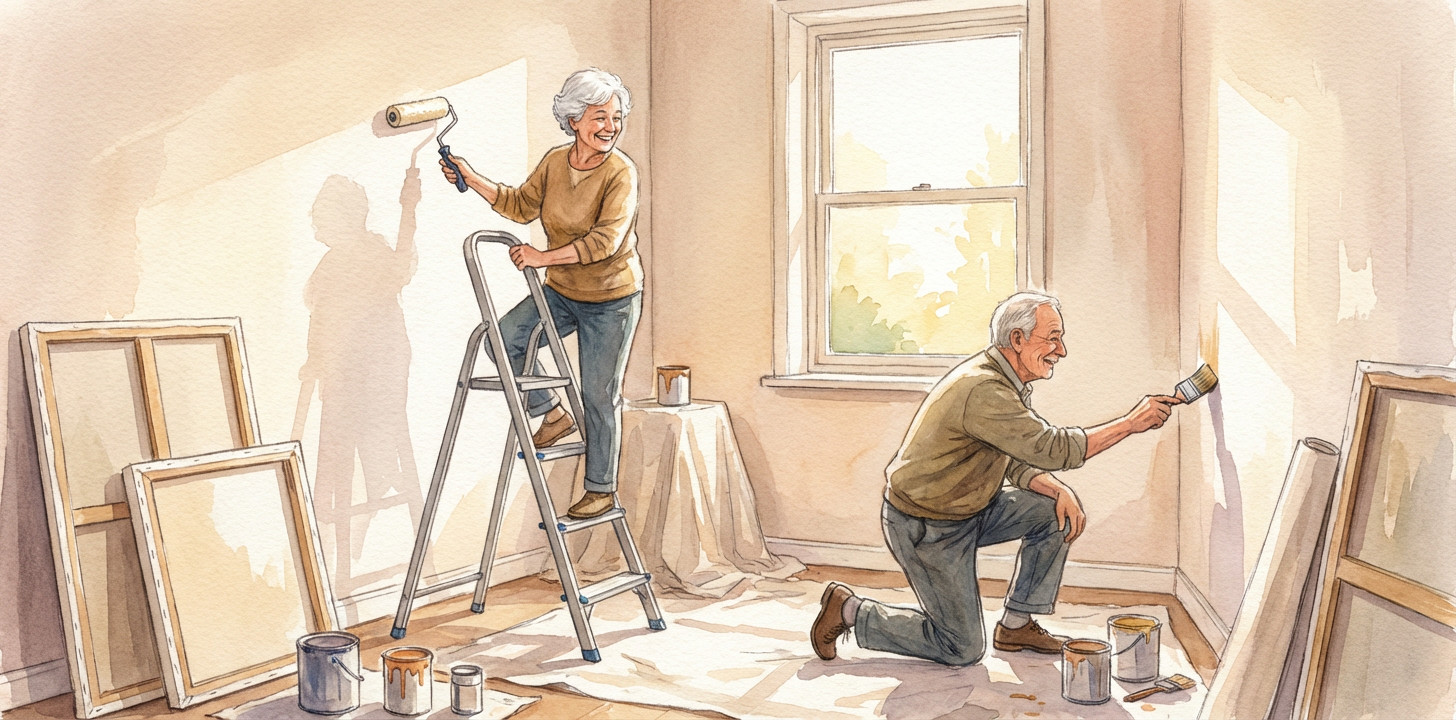
This series looks at how our housing needs change as we get older and offers common strategies for dealing with those changes. In the previous articles in this series, we looked at downsizing and decluttering. This time, we will look at another approach - staying put.
This article is intended for informational purposes and does not constitute financial, legal, or medical advice. Readers are encouraged to consult qualified professionals when making housing, financial, and healthcare decisions.
Why Many Choose to Stay
For a significant majority of older people, the preferred answer to the housing question is simple: stay right where I am. This is not merely anecdotal sentiment. Surveys have consistently found that the majority of adults over 50 express a strong desire to remain in their current home and community for as long as possible. When researchers probe the reasons behind this preference, the answers are consistent and deeply human.
Emotional attachment tops the list. A long-term home is not just a building — it is the physical embodiment of a life story. The pencil marks on the door frame tracking children's growth. The garden planted from seeds. The reading chair positioned just so to catch the afternoon light. These are the textures of a life, and leaving them behind is not a neutral act. For someone who has lost a spouse, the home may feel like the last tangible connection to that shared life, a place where the person's presence is still felt in every room.
Community roots run equally deep. Over twenty or thirty years in one neighbourhood, or maybe even more, casual acquaintances become genuine friends. You know the postman by name. You have a standing date at the same coffee shop. Your doctor has treated you for twenty years and knows your history. Your church, your book club, your walking route — these form the connective tissue of daily life. Social scientists refer to this as "social capital," and it is extraordinarily difficult to rebuild from scratch.
There is also a case for financial predictability. For homeowners who have paid off their mortgage — a group that includes a majority of UK homeowners over 65 — the ongoing housing costs are relatively stable and relatively low. Council tax, home insurance, and routine maintenance are not trivial expenses, but they are generally far less than rent in many markets, especially in big cities. The home represents both a place to live and a significant financial asset that can be tapped, if needed, through equity release (sometimes called a reverse mortgage) or an eventual sale.
Finally, there is the simple power of familiarity. Navigating a known environment — where every light switch, every step, every creaky floorboard is mapped in muscle memory — is cognitively and physically easier than learning a new space. This is true for everyone, but it is especially important for individuals with early-stage cognitive impairment, for whom an unfamiliar environment can be profoundly disorienting and anxiety-inducing.
Making Ageing in Place Work
Wanting to stay is one thing. Being able to stay — safely, comfortably, and without undue burden on loved ones — is another. Ageing in place successfully requires deliberate planning and, in most cases, meaningful investment in the home, in services, and in social infrastructure.
Home modifications are the foundation. The home that worked beautifully at forty may present real dangers at seventy-five, and those dangers can often be mitigated with relatively affordable changes. Bathrooms are the highest-risk area. Consider grab bars beside the toilet and in the shower. A walk-in or roll-in shower to replace a traditional bathtub, non-slip flooring, and a raised toilet seat are among the most impactful modifications. Outside the bathroom, improving lighting throughout the home (particularly in hallways, stairwells, and at entryways) is critical, as ageing eyes need significantly more light to see clearly. A no-step entry, whether through a ramp, a gently graded walkway, or a zero-threshold door, ensures wheelchair or walker access if needed.
For multi-story homes, the question of stairs looms large. Converting a first-floor room into a bedroom and ensuring there is a full bathroom on the main level can allow someone to live entirely on one floor if climbing stairs becomes unsafe or impossible. Stair lifts are another option, though they are expensive, require maintenance, and can become impractical if cognitive decline makes operating them unsafe.
Smart home technology has rapidly expanded the toolkit for ageing in place. Medical alert systems, worn as pendants or wristbands, allow a person to summon help with the press of a button. Video doorbells let residents see who is at the door without getting up. Voice-activated assistants like Amazon Alexa or Google Home can set medication reminders, make phone calls, control lights and thermostats, and provide companionship through music, news, and conversation. More advanced systems include motion sensors that detect unusual patterns of activity (or inactivity) and alert family members or caregivers if something seems wrong.
In-home services are the second pillar. As physical capacity changes, routine tasks, such as cooking, cleaning, food shopping, and gardening, may become difficult or impossible. Fortunately, a wide range of services exists to fill these gaps. Supermarket home delivery, and perhaps making more use of good-quality ready meals, can ease the burden of shopping and cooking. Home health aides can assist with personal care, medication management, and light housekeeping. Professional cleaning, gardening, and handyman services can take over the home's physical maintenance. And there are hairdressers, opticians and chiropodists who will do home visits.
The third, perhaps most frequently neglected, pillar is community and social engagement. The greatest risk of ageing in place is not a leaky roof or a broken hip. It is loneliness. There is an epidemic of loneliness and isolation, and social disconnection has been described as a public health crisis, with health consequences comparable to smoking fifteen cigarettes a day. Older adults who live alone are particularly vulnerable, especially if driving is no longer an option and public transportation is limited.
Combating isolation requires intentional effort to maintain regular social contact. Join a club. Volunteer. Take a class. Accept invitations. Make phone calls. Loneliness is not an inevitable consequence of ageing, it is a condition that can be prevented and treated with connection.
Transportation deserves special attention in this discussion. For many people, driving is the primary means of mobility and independence. But the time may come when you have to stop driving, whether due to vision loss, cognitive decline, or physical limitation. The impact on independence can be devastating, particularly in suburban and rural areas with limited public transport. Planning for this eventuality should be part of any ageing-in-place strategy. Options include ride-sharing services like Uber. There are volunteer driver programs operated by charities and non-profits (for example, Age Concern). In some areas, the NHS have lists of volunteer drivers, specifically for medical appointments. Some local authorities offer special minibuses with more flexible routes than buses (essentially shared taxis). And, of course, many older people make informal arrangements with neighbours or family.
Challenges and Pitfalls of Staying Put
As we have seen, ageing in place is not without substantial risks, and ignoring those risks in favour of wishful thinking benefits no one. Here are some other points to consider.
Escalating maintenance costs are a relentless reality. Older homes, by definition, require more upkeep. A roof nearing the end of its lifespan, an ageing heating system, outdated plumbing or electrics, or even structural issues. Any one of these can produce a four or even five-figure repair bill. On a fixed income, such expenses are not just inconvenient, they can be financially catastrophic. Deferred maintenance only compounds the problem, as small issues grow into large ones and a home gradually becomes unsafe or unsellable.
Social isolation is the other great danger, particularly as same-age neighbours move, enter care facilities, or pass away. As a new generation moves in, a neighbourhood that was once connected and familiar transforms into a place where you no longer know anyone. Without the daily incidental contact that comes from a workplace, a school community, or an active neighbourhood, weeks can pass with very little human interaction. This is not just sad, it can be medically dangerous.
Caregiver strain often accompanies the decision to age in place, particularly when professional care is unavailable or unaffordable. Adult children may find themselves managing their parents' home, driving them to appointments, handling medications, and providing personal care, all while juggling their own careers and families. This unsustainable burden can damage the caregiver's health and well-being, strain family relationships, and, paradoxically, hasten the very institutional placement it was meant to prevent.
There is also the uncomfortable reality of denial. Some people choose to stay in their home not because it is genuinely the best option but because they are unwilling to confront changes in their own capacity. People sometimes stay in an unsuitable home out of stubbornness or fear, in a home with stairs that can no longer be navigated safely, in a kitchen that is a fire risk, in a neighbourhood where help is far away. That is not ageing in place. It is ageing in danger. The distinction matters, and it requires honest self-assessment, ideally supported by trusted family members and medical professionals.
Finally, there is the opportunity cost of equity locked in a home. A house worth £300,000 or more that is fully paid off represents substantial wealth, but it is illiquid wealth. It cannot pay for groceries, bills, travel, or experiences unless it is sold or borrowed against. For some people, the wisest financial move is to convert that equity into money that can actively support a higher quality of life.
Making it Work: Practical Advice
If staying in your home is your goal, then it is well worth getting advice. Ideally, you should do that ahead of time rather than waiting until you are struggling. Some good sources of help and advice are:
- Your local council, which provides many services including help in the home, and even some safety modifications such as fitting handrails and similar. Some of these may even be free of charge.
- The NHS can advise on social care and support.
- Age Concern also has an advice line
You might consider creating a written ageing-in-place plan. This document lists specific trigger points and corresponding actions. For example:
- If I can no longer safely drive, I will use XYZ transportation service.
- If I fall more than once in six months, I will consult my doctor about assisted living options.
- If I can no longer manage the stairs, I will convert the dining room to a bedroom.
This kind of advance planning removes the pressure of making critical decisions in a moment of crisis. This plan can be just for you or shared with family.
Explore equity release. These products allow homeowners to borrow against their home's equity, receiving funds as a lump sum or monthly payments. They can be a legitimate tool for funding ageing-in-place modifications, supplementing retirement income, or covering healthcare costs. However, they are complex financial instruments with significant fees, interest that compounds over time, and requirements that borrowers continue to maintain the home and pay council tax and insurance.
Finally, assemble a "personal board of directors". That is, a circle of trusted advisors and advocates who can provide guidance, accountability, and honest feedback. This board might include a financial planner, a legal advisor, a primary care physician or geriatrician, and a candid friend or family member who has permission to say the hard things. No one should navigate the complexities of ageing alone, and having a team in place before a crisis occurs is an act of wisdom, not weakness.