When "Just Have Faith" Isn't Enough
Categories: christianity
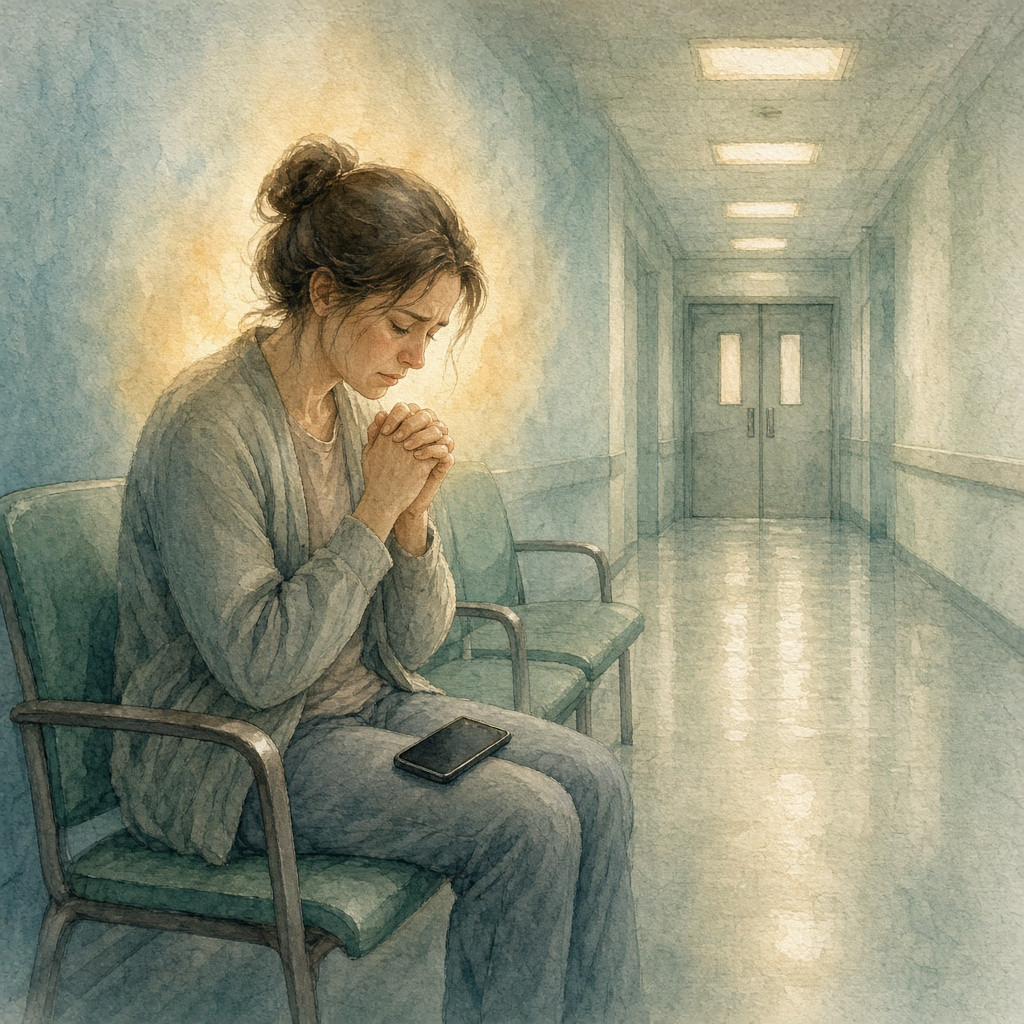
The fluorescent lights in the hospital hallway hummed the same note they had been humming for six hours. Sarah sat on a vinyl chair the color of oatmeal, her phone buzzing with texts she couldn't bring herself to read. "Praying for you!" "God's got this!" "He works all things for good!" Each message arrived with the cheerful urgency of a text about weekend plans, and each one landed in her chest like a small stone.
Her son was three years old. He was somewhere behind the double doors at the end of the hall, and no one had come out to tell her anything for longer than she could stand.
A woman from her church small group had stopped by earlier, squeezed her hand, and said the thing people say: "Just have faith. God is good. He won't give you more than you can handle." Sarah had nodded. She had even said, "Thank you." And then the woman left, and Sarah sat alone with a truth she didn't dare say out loud:
She didn't feel like she had faith. She felt like she was drowning.
She loved God. She had loved God since she was a girl memorizing verses on flashcards, since youth camp bonfires and the quiet certainty of Sunday mornings. But right now, in this hallway, faith didn't feel like a comfort. It felt like a performance she no longer had the strength to give. Everyone around her seemed to expect a kind of steady, smiling trust, and she had nothing steady left in her at all.
So she did what so many of us do in moments like this. She folded her hands, closed her eyes, and forced her lips to move around words she wasn't sure she believed anymore.
"God is good. God is good. God is good."
She said it like a mantra, like a spell, like something she could will into being true simply by repeating it enough times. But underneath the words, silent and unspoken, another thought persisted, the one she was most ashamed of:
Then why does it feel like You've left me here alone?
The Gap Nobody Talks About
If you have ever sat in a version of that hallway, literal or otherwise, you know the particular loneliness of that gap. It's the space between what you were taught to feel and what you actually feel. Between the faith you're supposed to perform and the grief you're actually carrying.
Maybe your hallway wasn't a hospital. Maybe it was a bedroom at 2 a.m. after your spouse said they wanted a divorce. Maybe it was a job you loved, ended by an email with a subject line you'll never forget. Maybe it wasn't one dramatic moment at all, but a slow leak — years of disappointment, a prayer that never seemed to get answered, a body that betrayed you, a child who walked away, a dream that quietly died somewhere along the way, and nobody sent flowers.
Whatever your hallway was, chances are someone told you, in one form or another, just to have faith. And chances are you tried. You said the right words. You sang the songs with your hands raised even when your heart was on the floor. You told people you were "blessed" when you were, in truth, barely holding on.
Here's what almost no one tells us in church: that gap is not a failure of faith. It might be the most honest place faith can stand.
Where We Learned to Perform Instead of Grieve
Most of us were never taught how to grieve. We were taught how to recover — and quickly.
We learned, often without anyone saying it directly, that doubt is dangerous, that sadness signals weak trust, and that anger at God is somewhere close to sin. We learned that the "mature" Christian response to suffering is an immediate turn toward gratitude, an instant reframe toward the silver lining, a testimony wrapped up with a bow before the wound has even stopped bleeding.
Call it the tyranny of the immediate silver lining: the unspoken pressure to resolve pain before we've actually felt it. We rush toward "but God is still good" because we don't know what else to do with the terrifying, formless weight of "this is not okay."
It's not that anyone set out to teach us this. Most of the people who taught us to "just have faith" meant well. They were often repeating what had been said over them in their own hallways. Somewhere along the way, sincerity got mistaken for depth, and cheerfulness got mistaken for trust. We inherited a faith with plenty of room for celebration and almost none for grief.
And so we learned to hide the second half of our sentences. We say "I'm struggling, but God is good" and stop there, as if finishing the thought — and I don't know what to do with how much this hurts — would somehow disqualify us. We learned to grieve in private and perform peace in public, and we called that peace maturity.
What It Costs Us to Stay Silent
That performance has a cost, and it is rarely small.
Some of us grieve alone, convinced that no one else could possibly understand the particular shape of our pain, because we've never seen anyone else's real shape — only their curated calm. We sit in rooms full of people and feel more isolated than if we were actually by ourselves, because the isolation of being surrounded by people who don't know the truth about you is its own specific ache.
Some of us drift. Not dramatically — we don't usually announce that we're leaving faith behind. We just quietly stop bringing our real selves to God, because we've concluded, somewhere below the level of conscious thought, that God only wants the polished version anyway. And a relationship where only the polished version is welcome is not much of a relationship at all. It withers. People walk away from churches — and sometimes from God altogether — not because they stopped believing in Him, but because they stopped believing there was room for the truth of their lives inside that belief.
Some of us delay. We push grief down for months or years, and it doesn't disappear — it just waits. It resurfaces later, often at moments that seem to make no sense, because the sadness we never let ourselves feel in the hospital hallway is still fully intact, still waiting for permission, showing up instead at a stoplight, a wedding, a random Tuesday.
And nearly all of us carry shame. We look at our own doubt, our own anger, our inability to muster the "right" feelings, and we quietly conclude that something is wrong with us. That other Christians must have a stronger faith, a closer walk, a deeper trust. We rarely stop to ask whether the problem might not be us at all. It might be the framework we were handed.
If any of this sounds familiar, I want to say clearly, before we go any further: nothing is wrong with you. You are not a bad Christian for feeling what you feel. You have simply never been shown what to do with those feelings.
A Discovery That Changes Everything
Here is where the story takes an unexpected turn. The discovery that eventually became the reason for this book.
Years ago, in a season not unlike Sarah's hallway, I started actually reading the Psalms instead of skimming past the uncomfortable ones. And what I found stopped me cold.
Nearly a third of the 150 psalms - the church's oldest prayer book, the songs Jesus himself would have sung - are not songs of triumphant praise at all. They're songs of complaint. Songs of confusion. Songs, sometimes, of open anger at God.
"How long, O Lord? Will you forget me forever?" the psalmist cries in Psalm 13. Not "I trust You no matter what," at least not yet — but "How long?" A real question, asked to a real God, without the comfort of an answer.
There's an entire book of the Bible — Lamentations — devoted almost entirely to grief. Five chapters of a people watching their city, their temple, their whole world collapse, and refusing to rush past the wreckage toward a tidy conclusion.
And then there is Jesus. Not a stoic Jesus who faces suffering with a serene, untroubled smile, but a Jesus who weeps at his friend's tomb even though he knows resurrection is only moments away. A Jesus in a garden, so anguished that he asks, if there is any way, for the suffering ahead to pass from him. A Jesus on a cross, quoting the opening line of a lament psalm with his last strength: "My God, my God, why have you forsaken me?"
If Jesus himself prayed that way, then perhaps the pressure I'd felt my whole life to skip straight to praise wasn't actually biblical faith at all. Perhaps it was something else — something narrower and more fragile than what Scripture actually offers.
There is a word for this ancient, honest way of praying. It's called lament, and its definition is far simpler than the word sounds:
Lament is the honest cry of a hurting heart to a God who is still listening.
That's it. Not despair without hope. Not anger that walks away from God. Lament is grief that stays in the room. It's the difference between shutting the door on God and slamming it as loud as you can — while still, somehow, staying on the same side of it as Him.
What This Book Is — and What It Isn't
I want to be honest with you about what these pages will and won't offer, because I think false promises have hurt you enough already.
This book won't explain why your suffering happened. I don't know why your son was in that hospital bed, or why your marriage ended, or why the diagnosis came back the way it did. I won't pretend to.
This book isn't asking you to stay in your pain forever, either. You don't need to treat despair as a destination or grief as a permanent home. That would be its own kind of trap.
Instead, this book is an invitation into an old and deeply biblical way of bringing your whole self, your grief, your confusion, your anger, your doubt, all of it, into the presence of God, instead of leaving it at the door.
We'll look at how the lament psalms are actually structured, and what they can teach us about praying honestly (Chapter 2 onward). We'll sit with the psalms that never resolve into hope at all, and ask what that means for the nights when your own prayers don't resolve either. We'll look at Lamentations, and at Jesus, the man of sorrows, who somehow leads us not away from pain but through it. We'll learn how to write our own laments, in our own words, for our own losses. We'll talk about grieving in community, not just alone. And in time — not rushed, not forced — we'll talk about how honest lament, strangely, is often what clears the ground for real hope, rather than the fragile, borrowed kind.
Coming Back to the Hallway
I think often about Sarah, sitting in that hallway, forcing the words God is good through clenched teeth while a truer sentence waited beneath them, unspoken and unwelcome.
I wonder what might have been different if someone had sat down next to her — not with another verse about God's goodness, but with permission. If someone had simply said: You don't have to pretend right now. You're allowed to tell God exactly how this feels. He can handle it. He's not asking you to be strong. He's asking you to be honest.
If you've ever sat in the wreckage of your own life, mouthing words you didn't fully believe because you thought that's what faith required of you, then this book is for you. You don't have to perform anymore. An older, truer way to pray has been sitting in your Bible the whole time, waiting for you to notice it.
"How long, O Lord? Will you forget me forever? How long will you hide your face from me?" Psalm 13:1
For Reflection
- When have you felt pressure to "just have faith" instead of being honest about your pain?
- What emotions have you been afraid to bring to God — anger, doubt, exhaustion, despair?
- Where in your life right now do you need permission to be honest, rather than simply positive?